|
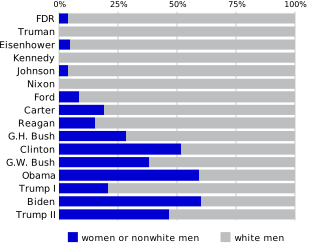
Diversity is Not Enough: The Ironies of Trump's Second Cabinetby Richard L. Zweigenhaft, Guilford CollegeJuly 2025In Donald Trump's second presidential term, "diversity" has become a dirty word. However, that does not mean that social scientists who study the increases and decreases in diversity in the power elite will stop paying attention to the presence or absence of women, Blacks, Asians and others who are not white men in positions of power (Zweigenhaft and Domhoff, 2018; Zweigenhaft, 2021). Indeed, as anyone who has taught (or taken) sociology courses with titles such as "Class, Race, and Gender" know quite well, in order to understand power in America, and the pathways that can lead to positions of power, it is necessary to examine these and other demographic categories, individually and in combination with one another. Are opportunities for those previously excluded from power still increasing? What can be learned about trends in diversity from studying the backgrounds of the 15 members of Trump's 2025 cabinet, and how does it compare to his initial cabinet when he was elected to the presidency for the first time in 2016? What are the pathways they have taken, and have they changed? What new conclusions can be drawn from his 2025 appointments? It should be noted that over time cabinet positions have changed. I have used the ones that were designated officially as cabinet positions when each President was in office. The current 15 cabinet positions are: Agriculture, Commerce, Defense, Education, Energy, Health and Human Services (HHS), Homeland Security, Housing and Urban Development (HUD), Interior, Justice, Labor, State, Transportation, Treasury, and Veterans Affairs. I have not included the various cabinet-level positions (such as Environmental Protection Agency (EPA), Office of Management and Budget (OMB) or the representative to the United Nations), even though some Presidents have included them in cabinet meetings, and over the years some people have lobbied for certain of these to be designated as full cabinet positions. The "Not-A-White-Male" Percent: A simple metric for gender and ethnic diversityThe first diversity appointment to a presidential cabinet in the modern era occurred in 1933, when Franklin D. Roosevelt (FDR) appointed an old-line, middle-class Massachusetts white woman, Francis Perkins, to be the Secretary of Labor. Perkins had been educated at Mount Holyoke, one of the "elite colleges ("the Seven Sisters") that had been founded for women who had been raised with economic privilege. She then earned an M.A. degree in economics and sociology, and became a progressive social worker in New York City, where she was distressed by the working conditions she encountered. From her key post as Secretary of Labor — her appointment shocked the leaders of the old-line craft unions — she oversaw the creation of the Social Security Act of 1935, along with other innovations to help workers. She served in this position until FDR's death in April, 1945. When asked shortly after her appointment if being a woman had any handicaps, she replied, "Only in climbing trees," which referred to the fact that proper woman were expected to wear skirts and dresses in that era (Woolf, 1934). President Dwight D. Eisenhower appointed Oveta Culp Hobby, a white Episcopalian woman as his Secretary of Health, Education, and Welfare in 1953. Though she started college at the University of Texas but not did complete her degree she was married to a lawyer who owned a major newspaper. In 1966, Lyndon Johnson appointed Robert Weaver, a Harvard educated Black man (his grandfather, a dentist, had also gone to Harvard,) as his Secretary of Housing and Urban Development (HUD), but presidents Truman, Kennedy, and Nixon appointed only white men to their cabinets. From 1933 to 1974, therefore, the Not-A-White-Male Percent, calculated by dividing the number of those who were not white men by the total number of cabinet members in that era, was 2% (three out of 149). (The Not-A-White-Male % is also useful because it is a reminder that "whites" have color, too; I have recommended, as have others, that the phrase "people of color" be phased out; see Zweigenhaft, 2024, note 5, and Zweigenhaft, forthcoming.) It was not until 1974, when Vice-President Gerald Ford became the president, after President Richard Nixon resigned in the face of incontrovertible evidence that he had conspired to cover up the illegal break-in into the Democratic headquarters located in the Watergate Hotel, that diversity began to increase in the cabinet. Ford appointed William Coleman, a Black man with a B.A. from the University of Pennsylvania and a JD from Harvard, born into a family of educators, ministers, and social workers, as Secretary of Transportation. Ford also appointed Carla Anderson Hills as Secretary of Housing and Urban Development (HUD). Hills, an Episcopalian whose father was a businessman, had an undergraduate degree from Stanford and a law degree from Yale. As can be seen in Figure 1, which tracks the Not-A-White-Male % from FDR to the current Trump cabinet, the percentage of those who were not white men increased steadily beginning with Ford's presidency, though it declined slightly when Reagan was President. It then declined dramatically in Trump's first term (to 20%), but increased to 60%, its highest level, during Biden's presidency (slightly higher than during Obama's presidency when it was 59.4%).
Figure 1: Percentage of cabinet members who were not white males,
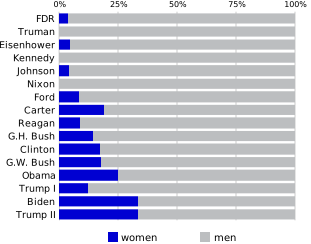
Somewhat surprisingly, and ironically, given his antagonism to DEI, Trump's initial cabinet in his second term, with a Not-A-White-Male % at 47%, is more than twice as diverse as his cabinet during his first term, though it is still less diverse than Biden's, Obama's, or Clinton's cabinets. Trump's initial second-term cabinet included five women, one Black male, and one Latino, along with eight white men. It is worth keeping in mind that according to the 2010 census, white men make up 31% of the American population, so they continue to be very much over-represented in presidential cabinets. It is also worth keeping in mind that this diversity metric does not include gay men and lesbians. If the diversity metric included gay men and lesbians, Biden's figure would be higher because Pete Buttigieg, who served as his Secretary of Transportation from 2021-2025, came out as a gay man in June 2015 when he was the Mayor of South Bend, Indiana. And the Trump diversity figure would also be higher, because his Secretary of Treasury, Scott Bessent — a Wall Street financier who supported Barack Obama for president in 2008 and Hillary Clinton in 2016, and made his first hundreds of millions working for George Soros — has been married to a man since 2012. And like Buttigieg, who married in 2018, Bessent and his husband have two children. His estimated net worth, according to Forbes, is around $600 million. Within this context, who are Trump's 2025 appointees, and how do they differ from previous cabinet members, including those he appointed to his first cabinet? The five womenTrump's cabinet includes four white women and one Mexican American woman. The white women are Pam Bondi, Attorney General; Brooke Rollins, Secretary of Agriculture; Linda McMahon, Secretary of Education; and Kristi Noem, Secretary of Homeland Security. Lori Chavez-DeRemer, a Mexican American, is the Secretary of Labor. Strikingly, and again ironically, his cabinet is as diverse in terms of the percentage of women as Joe Biden's cabinet, which (at 33%) had established an all-time high. As can be seen in Figure 2, Trump therefore continues the trajectory of greater representation of women in presidential cabinets that has taken place since FDR appointed the first woman to a cabinet 92 years ago.
Figure 2: Percentage of women in cabinets,
Members of the traditional power elite, rooted as they are in an "Eastern Establishment," frequently boast educations from high-status private schools with labels such as "The Ivy League," "The Little Ivy," and the "Seven Sisters." But the five women in Trump's current Cabinet have very different educational backgrounds than the previous 37 women who have served in presidential cabinets (going back to Frances Perkins, the Secretary of Labor from 1933 to 1945). In addition to having high-status undergraduate educations, consistent with their privileged class backgrounds, more than 75% of the previous 37 women had earned higher degrees (M.A. and MBA degrees, JDs, and Ph.D.s) and many of these degrees were from Ivy League schools that had been founded long ago to educate well-off Americans (eight had earned degrees from Harvard, four from Yale, and many others were from Ivy League schools or other prestigious liberal arts colleges). In striking contrast, only two of the five women in Trump's current cabinet (that is, 40%) earned higher degrees, both law degrees. Bondi, whose undergraduate degree is from the University of Florida, has a law degree from Stetson, and Rollins, whose undergraduate degree is from Texas A & M, has a law degree from Texas. The other three (McMahon, Noem, and Chavez-DeRemer) have bachelor's degrees, and all three are from non-flagship branches of state schools (East Carolina University, South Dakota State, and CSU Fresno). Linda McMahon, the Secretary of Education, is especially noteworthy as she has virtually no experience in education. The National Association of Education opposed her nomination, arguing, that she had no relevant experience in education (Richards, 2024). Moreover, she has expressed support for Trump's desire to eliminate the very program that she has been named to lead. When asked in March 2025 on "Fox and Friends" if she thought the country needs a Department of Education, she replied "No, I don't" (Bender, 2025). By mid-April, she made clear that efforts to dismantle the Department were "moving in a very good direction" (Bull, 2025). She and her husband converted his father's World Wrestling Federation business into a multi-million-dollar enterprise. They contributed millions of dollars to the Donald J. Trump Foundation as early as 2006. She then contributed many more millions of dollars to Trump's election in 2016, and she was the co-chair of America First Action, a Super PAC that raised 83 million dollars for Trump's 2020 campaign. She also was the co-chair of his second transition team. A New York Times article was titled "Her Wrestling Empire Was Said to Harm Children. Trump Chose Her for Education," with a subheading that read, "Linda McMahon, whose résumé mainly rests on running World Wrestling Entertainment, has faced questions for years over whether she is suitable for important education posts" (Saul, 2024). The Senate confirmed her, 51-45. Trump's choice of McMahon was not the only one in which the proposed cabinet member had little or no relevant experience, as was apparent in the considerable opposition to his selection of Pete Hegseth to lead the Department of Defense and Robert F. Kennedy Jr. to be the Secretary of Health and Human Services. For McMahon, and many others in the cabinet, not relevant experience or competence, but having contributed a great deal of money to Trump's campaign, having demonstrated loyalty to Trump, or both, seem to have been prerequisites to appointments. The same pattern holds for education for the eight white men in Trump's second cabinet — that is, they have less impressive educational credentials than the white men in previous cabinets — though it is less pronounced. Two of the eight (Scott Bessant, Secretary of Treasury, and Howard Lutnick, Secretary of Commerce), or 25%, have BA degrees (Bessant from Yale, Lutnick from Haverford) but neither has an advanced degree. This has not been unheard of in previous cabinets, but a look at the educational backgrounds of the 60 white men who served in cabinets since 2000 (that is, in the cabinets of George W. Bush, Obama, Trump's first term, and Biden) reveals that only 12 of the 60, or 20%, had no advanced degrees. Moreover, though four of the eight white men in Trump's second cabinet have either JD or MBA degrees (the most frequent degrees earned by white male cabinet members over time), none had earned either an MD or a Ph.D., but eight of the previous 60 white male cabinet members, or 13.3%, held one of those two degrees. One Hispanic man and one Black manThe two nonwhite men in Trump's cabinet are Marco Rubio, the Secretary of State, and Scott Turner, the Secretary of Housing and Urban Development (HUD). Rubio is the son of parents who left Cuba in 1956, at a time when Castro was still in Mexico, plotting his return, but Rubio built his early political career in the Cuban-American community by claiming that his parents were "exiles" and had hoped to go back to Cuba someday. He only began to downplay this claim when the Washington Post told the full story in 2011 by which time he had already been elected to the Senate (Roig-Franzia, 2011). Rubio, who earned a B.A. from the University of Florida and a J.D. from the University of Miami, served in the U. S. Senate as a Republican from Florida from 2011 through 2025 and was consistently rated by conservative groups as one of the most conservative Senators (for example, the Club for Growth gave him a lifetime rating of over 90%). (McIntosh, 2015). Although he was berated and mocked by Donald Trump when he opposed Trump in the Republican primary for President in 2016 (among other things, the taller Trump called Rubio "Little Mario"), he subsequently endorsed Trump in 2016, and again in 2020, and 2024. As the first Hispanic Secretary of State (there have been 18 other Hispanic Cabinet members), Rubio is the highest-ranking Hispanic official in US history. Scott Turner, an African American, and a graduate of the University of Illinois, played cornerback in the NFL for nine years. After his NFL career ended, he became a motivational speaker and, a serious Christian, a "servant leader." He also served two terms in the Texas House of Representatives. From 2007 to 2023, he worked at Systemware, a software company in various capacities, including as the "corporate chaplain" and "chief inspiration officer" (Batheja, 2014). He served in the White House during Trump's first term as Director of the White House Opportunity and Revitalization Council. (Seven of the 25 African Americans who have served in Presidential cabinets have headed HUD.) Notably, there have been no people of Asian backgrounds in either Biden's cabinet or Trump's current cabinet. The last person with an Asian background to serve in a cabinet was Elaine Chao, the wealthy wife of Senator Mitch McConnell; she was the Secretary of Labor under George W. Bush from 2001 to 2009, and Secretary of Transportation under Trump from 2017 to 2021. Chao's father founded a New York-based shipping company in 1964, one that was estimated in 2019 to be worth hundreds of millions of dollars. At that time, Chao and McConnell were reported to have a net worth of $20 million (Tindera, 2019). What to conclude about diversity?The path to the cabinet was not the same for those in Trump's second-term cabinet as it had been in previous administrations, including his first-term cabinet, not only for these seven diversity choices, but for the eight white men. Educational background and relevant experience were less important than in the past, but loyalty (some commentators have pointed out that the term "fealty" is more accurate than "loyalty" when it comes to Trump — see, for example, Bolton, 2019, and Tumulty, 2020) to the new President was much more important than in the past. Merit — being qualified due to experience and expertise gained from positions in corporate or high-status policy-oriented non-profits — seems to have been ignored. By choosing people who have not taken the traditional avenues to power, Trump may be demonstrating that he is out to replace the old power elite with a new group in power, one that is friendly to, or at least willing to accept, authoritarian leadership. As David Remnick of The New Yorker put it, contrasting FDR's cabinet appointments with Trump's: FDR appointed "formidable advisors to his first Cabinet; Trump has empowered extremists distinguished principally by their conspiracy thinking, sycophancy, and incompetence" (Remnick, 2025, p. 15). Trump's first-term cabinet may not have been as formidable as FDR's was, but it was respectable in that he drew on former corporate chieftains like Rex Tillerson (CEO of ExxonMobil from 2006 to 2017), some people who had held positions in previous cabinets (for example, Elaine Chao, who was Secretary of Labor under George W. Bush from 2001-2009. and William Barr, the Attorney General under George H. W. Bush from 1991-93), and senior military leaders (for example, Jim Mattis and John F. Kelly, both of whom were four-star generals). These were people who had experience and expertise in the areas they were asked to lead. The term diversity has become a dirty word in part because it is typically associated with liberal or progressive thinking. But, if there is one thing we can learn from the diversity in Trump's cabinet, it is that to be diverse does not automatically equate with liberal or progressive thinking. A diverse group does not necessarily endorse inclusion or equality. A diverse group can be reactionary, or even authoritarian, and it can be incompetent. Future turnover in the Trump cabinet: Sycophancy versus incompetenceThis analysis, it should be noted, is based on the initial appointments to Trump's cabinet in his second term. There is always some turnover in cabinets. In Trump's first term, due to conflicts with the president that led to firings and resignations, there was extensive turnover: a total of 24 people held the 15 cabinet positions between 2016 and 2020 (not counting temporary appointments, which do not need congressional approval). For example, Jeff Sessions, a Senator from Alabama, was Trump's first attorney general, but Trump fired him in November 2018, after he recused himself from the investigation that was to take place into Russian interference in the 2016 election (Plott, 2020). William Barr, a former employee of the CIA and a corporate lawyer who had been Attorney General in the administration of George H. W. Bush from 1991-93, replaced Sessions. He stayed in office until December 20, 2020, when Trump, unhappy that Barr had stated that there was no evidence that the 2020 election had been rigged, announced that Barr would be stepping down (Benner, 2020). Barr was then replaced by Jeffrey Rosen, a corporate lawyer, who served as acting attorney general until Biden took office. Rex Tillerson, who had been CEO of ExxonMobil from 2006 to 2016, was Trump's first Secretary of State, but Trump asked him to resign in 2018. One of the reasons Trump cited for firing Tillerson was their disagreements over Iran. Tillerson was against rejecting the 2015 Iran nuclear deal, because Iran had lived up to the agreement, but Trump chose to withdraw the US from it, a decision that contributed seven years later to Trump's decision to support Israel by bombing nuclear facilities in Iran. Moreover, some months before he fired Tillerson, it had been widely reported that Tillerson, after a particularly frustrating meeting with Trump, had called him a "fucking moron" (Woodward, 2018; Liptak, Merica, Zeleny, and Labott, 2017; Kaplan, 2017). By way of comparison, though 24 people held the 15 cabinet positions during Trump's first term, 13 of the 15 George W. Bush cabinet appointees stayed for the entire four years of his first term, 13 of the 15 members of Obama first-term cabinet stayed for the entire term, and 13 of those in Biden's cabinet remained in their positions for all four years (in Biden's case, the other two were replaced for a year or two by temporary appointments). As I write this, in early July of 2025, Trump is approximately 165 days into his second term (though it seems like much longer!). Given his history of conflict with his cabinet members, one might expect to see Trump fire many of those in the current cabinet. However, as I have noted, those Trump has chosen for his cabinet have been selected because of their fealty to him. As New York Times columnist David French — who describes himself as an evangelical conservative — points out, Trump's cabinet "bears far more resemblance to a collection of North Korean generals than it does to a traditional American cabinet." He goes on to note that "Trump's cabinet meetings often feature its members publicly showering the president with praise, sometimes in the most absurd terms" (French, 2025). Given that Trump demands total loyalty, they are likely to do whatever he asks of them, so this cabinet may have less turnover than his first cabinet. In the rare cases when they take positions different than Trump's, they are likely to fall in line quite quickly. Those in the current cabinet are not likely to call Trump a fucking moron, as Tillerson did (Woodward, 2018). Within this authoritarian context, the determining factor creating turnover in Trump's cabinet may be the sheer incompetence of his appointments. Many — Republicans as well as Democrats — have called for Trump to fire Hegseth, the former Fox News Channel Weekend Host, who was barely confirmed as Secretary of Defense. As historian Heather Cox Richardson points out: "Hegseth has had no experience running an entity as large and complicated as the Defense Department, with its annual budget of $850 billion and its almost 3.5 million employees. The results of his appointment have been disastrous." Among the disasters we know about are his having used unsecure Signal chats that included family members to share information about battle plans in the Middle East (Richardson, 2025a). So, too, have many called for the resignation of Robert Kennedy, Jr., the Secretary of Health and Human services, who has failed to provide a clear and strong endorsement of vaccinations even as the largest number of measles cases have been reported in more than 25 years, including many deaths; and predictions are that without vaccinations, millions could be infected. Calls for Kennedy's resignation increased after comments he made about the cause and the nature of autism, and about nutrition and obesity (Associated Press, 2025). In three editions of our book, Diversity in the Power Elite, Bill Domhoff and I (Zweigenhaft and Domhoff, 1998, 2006, 2018) have explored what we have called "the ironies of diversity" (the title of the final chapter in each of those books). One central irony of diversity is that as a small number of people from previously excluded groups (Jews, women, African Americans, Hispanics, Asian Americans, gay men and lesbians, etc.) are granted entry into the power elite, the processes by which they are chosen and their very presence provide justification for the continuation of the status quo when it comes to power and the distribution of wealth. Trump's 2025 cabinet provides a case study of new ironies. For example, his cabinet includes five women, as high a percentage as has ever been in a presidential cabinet, with women like Pam Bondi and Linda McMahon, who certainly would not consider themselves feminists. But these five women would never have become cabinet members were it not for the activism of thousands of feminists before them, going back to the Suffragettes but also including the feminists of the 1960s. It seems ironic that women are likely to be re-subjugated while the cabinet includes the highest percentage of women it has ever had — and with Bondi, Trump's Attorney General, enforcing anti-abortion laws. It also seems ironic that Hispanic migrants and their children are being hunted down by unidentified masked men working for the federal government while Mark Rubio, the son of Cuban immigrants, is Secretary of State, even though his parents were migrants who came to the US to escape the Batista regime. I am not sure if it is irony or hypocrisy, but Rubio's parents did not become citizens until 1975, four years after Rubio was born in Florida. Therefore, if Trump's wishes about birthright citizenship were in place in 1971, Rubio might not have been granted citizenship. It is also puzzling, and perhaps ironic, that a Black man would be appointed to head HUD (which seems to be a token gesture to the Black community), when at the same time African American leaders of the Army have been fired or demoted, the military has eliminated emphasis on the important role played historically by Black soldiers, and renamed military bases after Confederate generals. With Trump and his 2025 cabinet, there are many ironies, though it is sometimes difficult to distinguish between that which is ironic and that which is puzzling or hypocritical. ReferencesAssociated Press (2025). "Fact Focus: Examining RFK Jr.'s Claims about Measles, Autism, and Diet as Head of HHS," April 21. https://apnews.com/article/rfk-vaccines-autism-measles-obesity-food-dye-f26089856550e978d28fd25b653d8103 Batheja, Aman (December 17, 2014). "In Bid for Speaker, Turner Looks to Beat the Odds," Texas Tribune. https://www.texastribune.org/2014/12/17/scott-turner-profile/ Bender, Michael (2025). "Asked if U.S. Needs Education Department, Its Head Says 'No'," New York Times, March 7. https://www.nytimes.com/2025/03/07/us/politics/education-department-mcmahon-trump.html Benner, Katie (2020). "William Barr is Out as Attorney General," New York Times, December 14. https://www.nytimes.com/2020/12/14/us/politics/william-barr-attorney-general.html Bolton, John (2025). "Presidents Expect Loyalty. Trump Demands Fealty." New York Times. January 5. https://www.nytimes.com/2025/01/05/opinion/trump-loyalty-cabinet-presidents.html Bull, Haley (2025). "McMahon says efforts to shut down Dept. of Education are "moving in a very good direction,'" Scripps News, April 11. https://www.scrippsnews.com/us-news/education/mcmahon-says-efforts-to-shut-down-dept-of-education-are-moving-in-a-very-good-direction French, David (2025). "No Ordinary Cabinet, No Ordinary Time," New York Times, April 30. https://www.nytimes.com/interactive/2025/04/30/opinion/trump-cabinet-members.html Kaplan, Fred (2017). "Trump's Nuclear Meltdown," Slate, October 11. https://slate.com/news-and-politics/2017/10/now-we-know-why-rex-tillerson-called-donald-trump-a-moron.html Liptak, Kevin, Merika, Dan, Zeleny, Jeff, and Labott, Elise (2017). "Tense and Difficult Meeting Preceded Tillerson's 'Moron" Comment," CNN Politics, October 12. https://www.cnn.com/2017/10/11/politics/tillerson-moron-comment/index.html McIntosh, David (August 5, 2015). "Rating GOP's pro-growth contenders: Club for Growth," USA Today. Archived from the original on August 8, 2017. https://www.usatoday.com/story/opinion/2015/08/05/gop-debate-pro-growth-candidates-column/31152497/ Plott, Elaina (2020). "The Fall of Jeff Sessions, and What Came After," New York Times, June 30. Updated July 14. https://www.nytimes.com/2020/06/30/magazine/jeff-sessions.html Remnick, David (2025). "Talk of The Town: Disgrace," The New Yorker. March 10. Richards, Zoë (2024). "Trump names former wrestling executive Linda McMahon as his pick for education secretary," NBC News, November 19. https://www.yahoo.com/news/trump-names-former-wrestling-executive-052353973.html Richardson, Heather Cox (2025). April 24, 2025. https://heathercoxrichardson.substack.com/p/april-25-2025 Roig-Franzia, Manuel (2011). "Marco Rubio's family story embellishes facts," Washington Post, October 20. https://www.washingtonpost.com/politics/marco-rubios-compelling-family-story-embellishes-facts-documents-show/2011/10/20/gIQAaVHD1L_story.html Santos, Sofia Ferrara (2025). "Tulsi Gabbard Now Says Iran Could Produce Nuclear Weapons 'within weeks'" BBC Online, https://www.bbc.com/news/articles/c056zqn6vvyo Saul, Stephanie (2024). "Her Wrestling Empire Was Said to Harm Children. Trump Chose Her for Education". The New York Times. https://www.nytimes.com/2024/11/28/us/linda-mcmahon-education-wrestling-wwe.html Tindera, Michaela (2019). "A 59 Million Will Sheds Light on Shipping Fortune Connected To Elaine Chao and Mitch McConnell," Forbes. June 10. https://www.forbes.com/sites/michelatindera/2019/06/10/million-will-sheds-light-on-shipping-fortune-connected-to-elaine-chao-and-mitch-mcconnell/ Tumulty, Karen (2020). "Bolton is Teaching Trump the Difference Between Loyalty and Fealty," Washington Post, January 30. https://www.washingtonpost.com/opinions/2020/01/30/bolton-is-teaching-trump-difference-between-loyalty-fealty/ Woolf, S. J. (1934). "Miss Perkins See New Hope for Labor," New York Times, August 5. https://www.nytimes.com/1934/08/05/archives/miss-perkins-sees-new-hope-for-labor-she-looks-to-arbitration-and.html Woodward, Bob (2019). Fear. New York: Simon & Schuster. Zweigenhaft, Richard L. and Domhoff, G. William (1998). Diversity in the Power Elite: Have Women and Minorities Reached the Top? New Haven: Yale University Press. Zweigenhaft, Richard L. and Domhoff, G. William. (2006). Diversity in the Power Elite: How it Happened, Why it Matters. Lanham, MD: Rowman & Littlefield. Zweigenhaft, Richard L. and Domhoff, G. W. (2018). Diversity in the Power Elite: Ironies and Unfulfilled Promises. Lanham, MD: Rowman & Littlefield. Zweigenhaft, Richard. (2021). "Diversity in Presidential Cabinets: From the Least Diverse in 30 Years to the Most Diverse Ever," On WhoRulesAmerica.net. https://whorulesamerica.ucsc.edu/power/diversity_in_presidential_cabinets.html Zweigenhaft, Richard L. (2024). The Unexpected and Dramatic Increase in Diversity on Top-50 Corporate Boards: Why Did it Happen and What Does it Matter? On WhoRulesAmerica.net. https://whorulesamerica.ucsc.edu/diversity/unexpected_increase_in_diversity.htmlWhoRulesAmerica.net Zweigenhaft, Richard L. (forthcoming). Why I Changed My Mind about Using the Term "People of Color." NotesThis document's URL: https://whorulesamerica.net/diversity/trump_second_cabinet.html |
||||||